"Do you know why you exist, Teddy? The world out there, the one you'll never see, was one of plenty. A fat, soft teat people cling to their entire life, every need taken care of except one: purpose, meaning. So they come here. They can be a little scared, a little thrilled, enjoy some sweetly affirmative bullshit, and then they take a fucking picture and they go back home." - William
****Minor Spoilers... No Material Plot Revealed****
HBO's hit show Westworld explores the concept of consciousness through the development of robotic entities called hosts. The show builds its theory though a train of thought similar to Hegel's historicism. I find this approach inadequate, and thus I propose a way to better the concept with whatever scant knowledge I have of theoretical psychology.
Ford's Theory of Consciousness
In Westworld, Ford builds upon his partner Arnold's theory of consciousness. Arnold thought that self-interest, or the voice of one's own in one's head, was the missing link in building consciousness. Thus Arnold's theory of consciousness hypothesizes three levels: 1) memory, 2) improvisation, and 3) self-interest, or the "voice in the head." In a scene where Ford explains to Bernard why he would implant painful memories, Arnold answered that suffering is the final path to consciousness, an element Arnold failed to grasp. Ford thinks that suffering leads to the realization that the world is not as one wants it to be, leading to a sort of epiphany of the condition of the world and of self. Before opening Westworld, Arnold found out that some of the robots already achieved in attaining the three elements. He thus opposed the opening of the park. But Ford wanted to open the park for he wanted the robots to be exploited under the human tourists; Ford saw that it was a necessary step for the robots to become conscious.
The theory of consciousness the show puts out is not totally fictional in a sense that the writers made them up from scratch. The theories they present are grounded upon the psychological tradition. The writers, I think, intentionally mirrored Arnold's idea to that of Titchener's theory of elements of the conscious mind, which are separated into three types: 1) sensations (memory created by sensing), 2) image (ideas leading to improvisation), and 3) affections (impulses of self-interest). Ford's theory, however, veers away from psychology as presented by psychologists and toward philosophical observations of human psyche. Ford's fourth element - suffering - reaches at a version of Hegelian historical dialectic.
Hegel opined that the realization of human freedom - full development of collective consciousness in psychological terms - as the ultimate purpose of history. The ultimate purpose, in Hegel's mind, is achieved when a perfect world is formed. In order to achieve this ultimate purpose, human beings would necessarily have to go through a journey of self-realization for the idea of this perfect world remains imperfect in our minds. In Ford's terms, a being would first have to have imprinted sensations or memories. From these memories, a being learns to adapt to different situations by formulating one's own ideas by inferring from past memories, i.e. improvise. But a being will eventually notice that certain situations require something more than inferences from past memories. To adapt to such situations, a being would have to develop affection, i.e. self-interest, to guide one's actions. However, a being will notice that one's affections cannot be met at times, and so one suffers. Finally, a being would realize that the world is not as it ought to be, and that one is not in a state one ought to be, arriving at a realization of the condition of this world and oneself. At this state of realization, a being achieved consciousness. In Hegel's terms, this being can increase in the degree of consciousness by constantly working toward a better condition by building a better world.
The Flaw of Ford-Hegelian Consciousness
Ford's Hegelian model of consciousness, I believe, suffers from a critical flaw: There is no real distinction between the mechanistic animal mind and a conscious mind when this model is assumed to be true. When Ford points to "The Creation of Adam," he declares that the hidden meaning behind the red cape shaped like human brain behind God is that the divine gift does not come from God, but rather our own minds. To him, the divine gift that is consciousness comes from the development of our minds over time in certain steps supposed by his theory. The key component of Ford's component is time (history). Through time a being develops consciousness. If we suppose that Ford's element is all there is and time is the only key factor in elevating the mind to make use of the elements, there would not be a real distinction between what we would call a conscious mind and the mechanistic animal mind.
It is undeniably true that animals have memory. For example, dogs know how to respond to certain calls made by humans. They further know how to improvise to a degree, depending on the species. For example, monkeys learned to use tools. Even a pet hamster I had years ago learned to unlock itself from its cage. Animals also have affection and learned to have self-interests. They may not be able to cognize words in their minds to a point where a "voice" is heard, but they can certainly discern their own self-interests. One may argue that human self-interests are different than those of the animals. Career, wealth, and positions of influence are not to be seen in the animal kingdom. However, such things are extensions of hoarding and primacy behaviors of every pack animals, from wolves to primates. To what would have been Arnold's dismay, Ford actually admits that there is no distinction, that the idea of the human mind being different is false if we suppose Arnold's notion to be true. Ford seems to think that adding suffering is the way to distinguish between the animal mind and the conscious mind. However, Ford's notion still does not escape the flaw of Arnold's theory.
The realization brought forth by suffering is not really special within humans. A dog can simply realize by suffering hunger that the condition he is in is not one he ought to be in. So he begs his master for food. The realization of human condition Ford speaks of is the same one as animals feel, the only difference being the fact that the human mind does the same thing with a greater intellect. As mentioned before, time is the key factor, the only one ever mentioned by the show, that synthesizes the elements into consciousness. If we allow time to synthesize Ford's four elements - memory, improvisation, self-interest, and suffering - all we would get is a historical dialectic based on desires within a being. The drive toward the perfect state made possible by suffering would merely be extensions want of desires that brought about the suffering. If we correlate want of a better condition purely on suffering, then the want is nothing but an extension of animal functions. Indeed, every desire can be reducible to evolutionary and biological functions. If a being desires a more bountiful world, he desires such a world for he suffered hunger, a animalistic desire. If a being desires a more free world, he desires such a world for he suffered oppression, a condition running contrary to the biological drive toward self-preservation. The animal impulses of mankind is too varied across too many situations, and there will always be deviant ideas, improvizations, formed by these impulses wreaking havoc upon the world for ideas cannot be killed. Thus the degree of consciousness we speak of is illusory, and this vision of Hegelian utopia will remain clouded and practicably impossible to be realized.
The Missing Factor
Is there a factor missing or is the notion of the conscious mind but a lie we tell ourselves as Broussais would have us believe? I believe so. It is to my opinion that, somewhere along the line, modern thinkers failed to get a clear sense of what a developed consciousness would look like, and the writers of Westworld fell to this deficiency. Ford in Westworld treated heightened consciousness as merely being aware of one's condition and that of the world. The deficiency is that animals are capable of doing this, that human beings are merely doing the same thing the animals are doing but with a higher level of intellect. True heightened consciousness lies not only in being aware, but being aware objectively.
So what is this missing factor that can mend Ford's flaw? The missing factor I speak of is self-denial. Self-denial is a process of introducing suffering upon ourselves. A religious person introduces suffering upon oneself by denying nutrients, and chaste person introduces suffering upon oneself by denying sexual relations. As the suffering progresses, one will find that letting go of such desires introduces objectivity, thus allowing heightened truth-seeking faculty of consciousness. Our forefathers long ago, across major religious traditions, envisioned the ideal of consciousness. Abrahamic religions called it God, Greco-Roman philosophies called it Logos, and Hindus and Buddhists called it Nirvana. The supreme consciousness has common attributes: omniscience. Omniscience is of course the ideal of truth-seeking faculty of a rational mind.
The Missing Factor Explained through St. John of the Cross
I think that, by way of failing to have a clear idea of consciousness, the writers, or rather Ford, made a misstep in interpreting the "brain" in "The Creation of Adam." There is actually a theological assumption behind it. The message is that God created Adam in His image and likeness, especially the rational nature of God. In Christian theology, God is the supreme Reason, the eternal conscious mind. Indeed, the gospel according to St. John states: θεὸς ἦν ὁ λόγος (Logos is God). In having us created in God's image and likeness, a human being is ordered toward becoming more like God. In a way, becoming more like God would be like becoming more in tune with our true rational nature. In terms of our subject, we would become more conscious. In describing God becoming man through Christ, Christian theology presents an idea of how a human being that has fully actualized his potential can look like, how a person who is fully in union with God would be like. In other words, through Christ, Christianity gives an idea of a man who has a fully developed conscious mind. The part of Christ relevant to our subject at hand is his ability to abstain from desires of the flesh.
This insistence on parting from the desires of the flesh, be it appetite for food or sex, is not totally unique to Christian tradition. In various religious traditions from Confucianism to Hinduism we see glaring examples of self-discipline as an essential path to higher consciousness. The Sacred Tradition affirms this truth through various Doctors of the Church. In fact, elements of consciousness can be mirrored to that of modern notions. In Book I Ch. IX of Ascent of Mount Carmel, St. John of the Cross lists the faculties of the soul: 1) understanding, 2) will, and 3) memory. In Titchener's terms, understanding is image, will is affection. St. John says: "when the soul, according to these three faculties, completely and perfectly embraces anything that is of the earth, it can be said to have its back turned toward the Temple of God." That is to say, when a soul (which is by nature conscious) embraces worldly things, the understanding of God will be darkened. In terms of the topic at hand, it would not be possible for a soul to attain a higher level of consciousness.
I believe that the truth of St. John's view can be seen in the real world. How many men and women do we see, aimlessly pursuing sexual partnerships without considering the consequences of the future? How many dead-end relationships do we see, oftentimes abusive, maintained only by the denial of inevitable split? How many are pursuing a life of crime, fully knowing that their days will be numbered either by death or imprisonment? Their greed somehow convinced them that such risks are worth taking and that it will be rewarding. Furthermore, how many still let poor parental upbringing affect their attitude toward the world and their own mental states? Such pitiful attitudes are not the ones had by those with heightened consciousness and well-formed conscience whose lives are led by reason and will. Rather, these attitudes are mere base extensions of lowly impulses. In these individuals, the unconscious governs their actions and their rational faculties used only to justify the unconscious wherein their impulses originate.
In order to increase the level of consciousness St. John of the Cross introduces an element external to the mind: 4) suffering. But unlike the kind of suffering Ford talks about, St. John's suffering comes primarily from sufferings inflicted upon oneself at will in the form of fasting and self-denial, not from oppressive external forces. This denial of pleasurable things of the earth he calls "the Dark Night of the senses." The reason for the soul to go through this Dark Night is that "all affections of which it has for creatures are pure darkness in the eyes of God, and, when the soul is clothed in these affections, it has no capacity for being enlightened and possessed by the pure and simple light of God." (Book I Ch. IV.1). In other words, a soul cannot become more in the likeness of God if one should be attached to worldly things. It should be noted that "senses" include the feeling of joy one can attain by fulfilling one's pride. That is to say, the "senses" does not include only the physical pleasures in the larger picture St. John of the Cross paints.
Synthesizing with Ford
As said above, Ford's model of consciousness cannot begin to realize the Hegelian utopia for it fails to filter out the deviant paths a being can take in pursuing one's desire to fix his suffering. This can be fixed by forming one's mind to view one's condition and of that world objectively. For objectivity has no place in an intemperate and prideful individual, the affection one has for pleasurable things and love of oneself ought necessarily be purged. And this purgation comes from self-denial, suffering inflicted upon oneself by will.
Along with the four elements, 1) sensations, 2) image, 3) affections, and 4) suffering, two factors of suffering must be introduced: 1) time, and 2) self-denial. Time will make one aware the corrupt condition of the world wherein one resides. Persistent self-denial (which in itself takes time) will grant objectivity so as to judge correctly the degrees and ways the world is corrupt, and, if exercised correctly, one would see the corruption within oneself. By introducing objectivity, one would not formulate deviant ideas about how to progress about one's condition. From what has been said, then, the deficiency of Ford's model of consciousness can be fixed by introducing self-denial, and attitude which embraces contemptus mundi.
This is where I share things that linger in my thoughts. A constructive feedback or a civil debate is welcomed. Forgive my clumsy typos. I don't go back to fix them. Ain't nobody got time for that.
Saturday, December 24, 2016
Tuesday, December 20, 2016
Bojack Horseman and the Pursuit of [False] Happiness
"The universe is a cruel, uncaring void. The key to being happy isn't a search for meaning. It's to just keep yourself busy with unimportant nonsense. And, eventually, you'll be dead." - Mr. Peanutbutter
***Spoiler Alert***
If you know me personally, I love watching depressing and existentially nihilistic movies/shows. Bojack Horseman is a show that was recommended to me, and I loved it. I like to reflect upon nihilistic thoughts in order to appreciate the goodness of my religion. I like to think of it as being something akin to St. John's journey through the dark night. The following is likewise a reflection upon the meaninglessness presented by Bojack Horseman.
Pursuit of Pleasures
Bojack lives in a large house acquired by his acting career. With his wealth, he can buy a large boat just because, and drown a Tesla in a pool and not care much about it. He also often throws lavish parties with his wealth, a sure opportunity for him to have sex with women who approach him just because, back in the 90's, he was in a famous TV show.
Running contrary to the supposedly attractive lifestyle he leads, the show's opening sequence makes one thing too clear: no matter how much you pursue pleasure, you will never be truly happy. The opening sequence switches between different places, and we see Bojack constantly consuming hard liquor. The places are usually places of pleasure or productiveness, ranging from a movie set to a rave party. Despite the amount of pleasures made available to him, he appears to be in need of something stronger to forget his unhappiness. What the show is telling us is that the pursuit of pleasures we often partake in, be it sex, money, or parties, they are all but distractions from our wretched condition.
Pursuit of Influence
We hear of of people who are married to their careers all the time. A lawyer who gets five hours of sleep on weekdays, a sales rep who does not spend enough time with his daughter, and a single investor who drops off her newborn with a nanny are our stereotypical model of individuals who do pursue their career as the focal point of their lives.
This mentality is represented by Princess Carolyn. She is an agent who tirelessly works to find jobs for her clients, one of whom being Bojack Horseman. She is extremely jealous of her coworker that is married and with a family. Yet, when she stopped working and when she was introduced to a perfect man that could very well open up to a way of life she is so jealous of, she finds a way to distract herself by renaming her career from "celebrity agent" to "celebrity manager," acting as if the two are really different. The show seems to get at how people at times distract themselves even from happiness because of the very fact that they do not really know what leads them to happiness. To Princess Carolyn, she has told herself a lie long ago that succeeding at her career is the sure path to happiness.
Another example is how Bojack does not feel anything once he found out that he was nominated for Oscars. In a conversation with Diane, Diane asked Bojack if winning an Oscar would make him happy, Bojack answered that it would... for a short while. To that, Diane asked: If the pleasure was only temporary and Bojack would go back to his miserable self again, why would winning it matter? Bojack admitted that him pursuing an Oscar is just a distraction. The meaninglessness of career heights is portrayed perfectly by Secretariat, a childhood hero of Bojack, who is incidentally a character portrayed by Bojack in a movie he got [falsely] nominated an Oscar for. Secretariat was the world's best runner. Even at his our of fame, Secretariat found a reason to commit suicide. To Secretariat, his running career was simply a distraction away from his pitiful state of existence.
Pursuit of Morality
Bojack Horseman paints a grim picture of our pursuit of moral accomplishments. The showmakers present how our moral pursuits are merely propelled by our selfish desires to feel better about ourselves.
This bleak painting is represented by Diane Nguyen. She is the stereotypical feminist of modern age. She is a journalist who tweets for people, willing to risk killing her husband's career over a sexual assault scandal caused by her husband's coworker, and wants to help children by doing journalism in some war-torn third-world country. It can be argued that she is the most moral main characters of the show.
However moral she may be, she never gets to be on top a hill, feeling like a hero for each moral thing she does. Even if she completes a supposed moral task, she feels defeated and feels as if nothing really meant anything. In an episode where she goes to Cordovia to document a philanthropist helping the children of a war-torn country, she realizes that the philanthropist only hired her not to publicize about the war, but to publicize about himself. Behind his selfish motive, she saw herself. Before going off to Cordovia, her main motive was to feel as if she was "doing some good" with her life; her motive for social activism was to satisfy herself not the common good. Another example is shown in the controversial abortion episode. Setting aside the debate on the moral weight of abortion, we find that Diane, soon after causing the making of a live-feed educational video on abortion fighting for the pro-abortion side, she talks of lying to the populous to make money; one perceived moral act done, an evil act done without blinking an eye.
The showmakers, through Diane, exposes the moral character of our modern day. To an existential nihilist, such ardent activists like Diane, so zealous for their causes, are merely attempting to escape their meaninglessness. Nietzsche observed in his day how democrats and communists pushed for their ideologies. Behind their moral claims, all Nietzsche saw was an attempt to give meaning through will to power, der Wille zur Macht. Do we not see the extent of this? We see too often so-called social activists claiming to be fighting for moral causes while committing habitually immoral acts such as intemperate outrages and lies to achieve their goals. In their minds, they feel as if committing to a moral cause would bring them happiness, or at least a fulfilling life, but ignore morality as a whole. True to Nietzsche's thought, their acts are merely distractions away from their mortality.
Does the Show offer Solution?
This is my take on what the show offers as a solution. I think that the show only offers only two possible solutions: familiar life and priestly life.
The show often presents how Bojack desires a true family. There was an episode of Bojack fantasizing about having a wife and a daughter. One another episode, he gets to take care of a baby seahorse, and he seemed to have a fulfilling time doing it. The evidence supporting this is scant, so I do not bank wholly on it. I think the showmakers are tad too pessimistic to conclude that a family can bring you happiness.
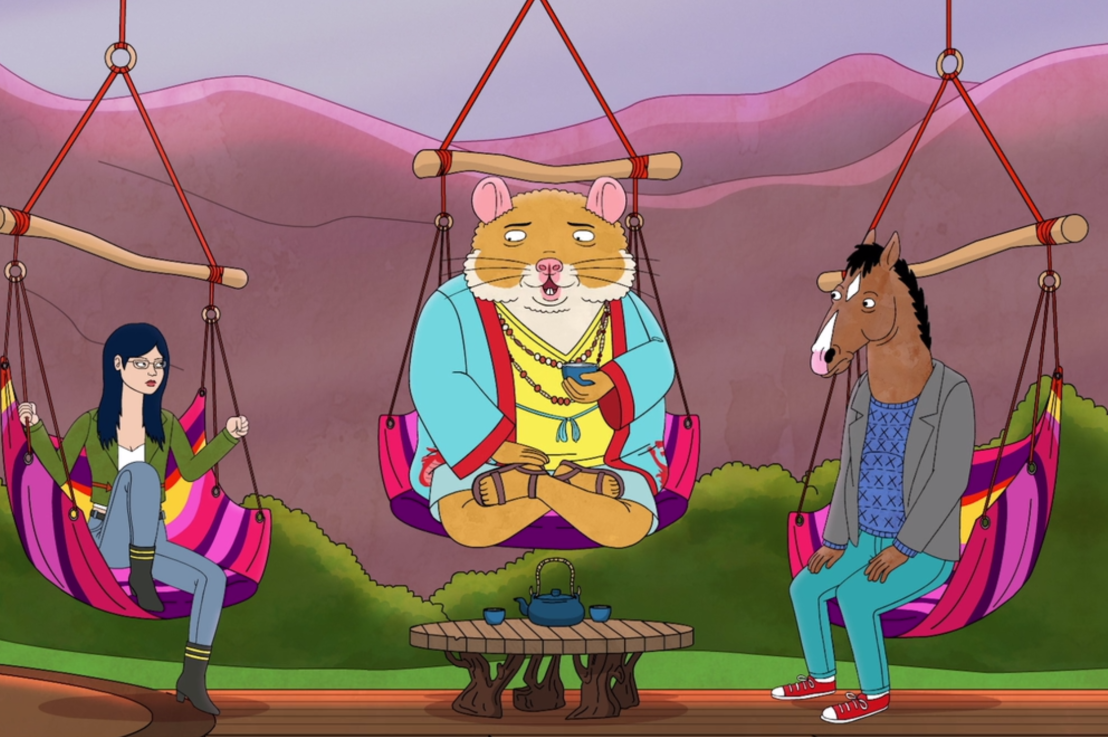
As for the priestly life, I do not mean that the show recommends a religious life. On the contrary, the show views religion in an unfavorable light. By "priestly life" I mean one which a person retreats away from the society simply to not give - to put it in modern colloquial terms - a shit. This concept is akin to the Absurd Hero, a hero who revolts against the absurdity of the world to stay happy as opposed to choosing suicide. This attitude is displayed by the hamster pictured above.
Is the "Priestly Life" a Valid Solution?
I think not. The idea of Absurd Hero is supposed to revolt against the absurdity and the wretched condition of the world. But how, exactly? This idea is merely in the hypothetical, a belief of which would be just as good as blind faith. If anything, believing in this idea is another form of distraction. In order to make us truly happy in light of the full realization of the absurdity of the world would need an ungodly effort toward psychological conditioning.
***Spoiler Alert***
If you know me personally, I love watching depressing and existentially nihilistic movies/shows. Bojack Horseman is a show that was recommended to me, and I loved it. I like to reflect upon nihilistic thoughts in order to appreciate the goodness of my religion. I like to think of it as being something akin to St. John's journey through the dark night. The following is likewise a reflection upon the meaninglessness presented by Bojack Horseman.
Pursuit of Pleasures
Bojack lives in a large house acquired by his acting career. With his wealth, he can buy a large boat just because, and drown a Tesla in a pool and not care much about it. He also often throws lavish parties with his wealth, a sure opportunity for him to have sex with women who approach him just because, back in the 90's, he was in a famous TV show.
Running contrary to the supposedly attractive lifestyle he leads, the show's opening sequence makes one thing too clear: no matter how much you pursue pleasure, you will never be truly happy. The opening sequence switches between different places, and we see Bojack constantly consuming hard liquor. The places are usually places of pleasure or productiveness, ranging from a movie set to a rave party. Despite the amount of pleasures made available to him, he appears to be in need of something stronger to forget his unhappiness. What the show is telling us is that the pursuit of pleasures we often partake in, be it sex, money, or parties, they are all but distractions from our wretched condition.
Pursuit of Influence
We hear of of people who are married to their careers all the time. A lawyer who gets five hours of sleep on weekdays, a sales rep who does not spend enough time with his daughter, and a single investor who drops off her newborn with a nanny are our stereotypical model of individuals who do pursue their career as the focal point of their lives.
This mentality is represented by Princess Carolyn. She is an agent who tirelessly works to find jobs for her clients, one of whom being Bojack Horseman. She is extremely jealous of her coworker that is married and with a family. Yet, when she stopped working and when she was introduced to a perfect man that could very well open up to a way of life she is so jealous of, she finds a way to distract herself by renaming her career from "celebrity agent" to "celebrity manager," acting as if the two are really different. The show seems to get at how people at times distract themselves even from happiness because of the very fact that they do not really know what leads them to happiness. To Princess Carolyn, she has told herself a lie long ago that succeeding at her career is the sure path to happiness.
Pursuit of Morality
Bojack Horseman paints a grim picture of our pursuit of moral accomplishments. The showmakers present how our moral pursuits are merely propelled by our selfish desires to feel better about ourselves.
This bleak painting is represented by Diane Nguyen. She is the stereotypical feminist of modern age. She is a journalist who tweets for people, willing to risk killing her husband's career over a sexual assault scandal caused by her husband's coworker, and wants to help children by doing journalism in some war-torn third-world country. It can be argued that she is the most moral main characters of the show.
However moral she may be, she never gets to be on top a hill, feeling like a hero for each moral thing she does. Even if she completes a supposed moral task, she feels defeated and feels as if nothing really meant anything. In an episode where she goes to Cordovia to document a philanthropist helping the children of a war-torn country, she realizes that the philanthropist only hired her not to publicize about the war, but to publicize about himself. Behind his selfish motive, she saw herself. Before going off to Cordovia, her main motive was to feel as if she was "doing some good" with her life; her motive for social activism was to satisfy herself not the common good. Another example is shown in the controversial abortion episode. Setting aside the debate on the moral weight of abortion, we find that Diane, soon after causing the making of a live-feed educational video on abortion fighting for the pro-abortion side, she talks of lying to the populous to make money; one perceived moral act done, an evil act done without blinking an eye.
The showmakers, through Diane, exposes the moral character of our modern day. To an existential nihilist, such ardent activists like Diane, so zealous for their causes, are merely attempting to escape their meaninglessness. Nietzsche observed in his day how democrats and communists pushed for their ideologies. Behind their moral claims, all Nietzsche saw was an attempt to give meaning through will to power, der Wille zur Macht. Do we not see the extent of this? We see too often so-called social activists claiming to be fighting for moral causes while committing habitually immoral acts such as intemperate outrages and lies to achieve their goals. In their minds, they feel as if committing to a moral cause would bring them happiness, or at least a fulfilling life, but ignore morality as a whole. True to Nietzsche's thought, their acts are merely distractions away from their mortality.
Does the Show offer Solution?
This is my take on what the show offers as a solution. I think that the show only offers only two possible solutions: familiar life and priestly life.
The show often presents how Bojack desires a true family. There was an episode of Bojack fantasizing about having a wife and a daughter. One another episode, he gets to take care of a baby seahorse, and he seemed to have a fulfilling time doing it. The evidence supporting this is scant, so I do not bank wholly on it. I think the showmakers are tad too pessimistic to conclude that a family can bring you happiness.
As for the priestly life, I do not mean that the show recommends a religious life. On the contrary, the show views religion in an unfavorable light. By "priestly life" I mean one which a person retreats away from the society simply to not give - to put it in modern colloquial terms - a shit. This concept is akin to the Absurd Hero, a hero who revolts against the absurdity of the world to stay happy as opposed to choosing suicide. This attitude is displayed by the hamster pictured above.
Is the "Priestly Life" a Valid Solution?
I think not. The idea of Absurd Hero is supposed to revolt against the absurdity and the wretched condition of the world. But how, exactly? This idea is merely in the hypothetical, a belief of which would be just as good as blind faith. If anything, believing in this idea is another form of distraction. In order to make us truly happy in light of the full realization of the absurdity of the world would need an ungodly effort toward psychological conditioning.
Sunday, November 27, 2016
Lack of Moral Dialogue and Conflicting Moral Sense in Legal Doctrines
Philosopher Alasdair Macintyre suggests that our modern moral landscape is like that of a dystonian future where the remnants of a civilization in a post-apocalyptic world are trying to recover lost sciences of the past. Their lead scientists are trying to piece together the technical advancements of the past, but they cannot pull together workable doctrines. That is because they cannot find all the necessary pieces of the puzzle. For example, when they try to piece together a formula for a vaccine, they find that they do not have a knowledge of microbiology. These scientists think that they are getting somewhere, but they have not a clue what they are doing.
Like so, our modern moral landscape is like trying to reasons morally with severely flawed moral doctrines. In Mactintyre's eyes, those flawed doctrines are utilitarianism, deontology, and noncognitivism. These moral doctrines are held sound by the moderns, and cannot see the nuanced and irreconcilable differences between these doctrines. In fact, they do not even know to distinguish the difference. To Macintyre, these flawed doctrines are trying to get at what the past civilizations used to determine right and wrong: virtue ethics, a system of ethics that was utilized by almost all major civilizations: Classical West, Abrahamic West, Confucian East, and Hindu India. Moderns think that they are getting somewhere in moral reasoning with these newer doctrines, but they do not realize that they do not know the moral doctrine that is truly missing.
As I am learning legal doctrines, I find myself at a loss as to how a particular doctrine can bring about a just decision. In criminal law, for example, the aim of strict liability is to deter undesirable results. In other words, to decrease unhappiness, a utilitarian aim. Strict liability is an exception to the intent requirement needed to convict someone of charges. Examining a specific intent of an individual to find a moral worth in an act is one of the central elements of virtue ethics. In order for the criminal legal system to excuse intent, one must assume the principles of utilitarianism. The majority of the law maintains principles from virtue ethics that Christian West used. And yet, at the same time, it allows utilitarian reasoning. One ethical system cannot be reconciled with another for they are by principle incompatible. But our law strangely allows this uneasy marriage. What is stranger is that many legal minds are quite content with this uneasy marriage. In fact, they barely notice the nuances of it.
Criminal law is a doctrinal representation of a society's moral sense. Perhaps we can see what Macintyre is talking about through modern law. We have conflicting moral doctrines making up the law, and yet people barely notice it or bothered by it.
Perhaps history will come around in fixing this problem. No western philosopher talked of virtue ethics except Catholics up until the 50s. Now, people seem to be seeing the flaws of newer ethical systems. Perhaps we will see a civilization centered around virtue ethics once more.
Like so, our modern moral landscape is like trying to reasons morally with severely flawed moral doctrines. In Mactintyre's eyes, those flawed doctrines are utilitarianism, deontology, and noncognitivism. These moral doctrines are held sound by the moderns, and cannot see the nuanced and irreconcilable differences between these doctrines. In fact, they do not even know to distinguish the difference. To Macintyre, these flawed doctrines are trying to get at what the past civilizations used to determine right and wrong: virtue ethics, a system of ethics that was utilized by almost all major civilizations: Classical West, Abrahamic West, Confucian East, and Hindu India. Moderns think that they are getting somewhere in moral reasoning with these newer doctrines, but they do not realize that they do not know the moral doctrine that is truly missing.
As I am learning legal doctrines, I find myself at a loss as to how a particular doctrine can bring about a just decision. In criminal law, for example, the aim of strict liability is to deter undesirable results. In other words, to decrease unhappiness, a utilitarian aim. Strict liability is an exception to the intent requirement needed to convict someone of charges. Examining a specific intent of an individual to find a moral worth in an act is one of the central elements of virtue ethics. In order for the criminal legal system to excuse intent, one must assume the principles of utilitarianism. The majority of the law maintains principles from virtue ethics that Christian West used. And yet, at the same time, it allows utilitarian reasoning. One ethical system cannot be reconciled with another for they are by principle incompatible. But our law strangely allows this uneasy marriage. What is stranger is that many legal minds are quite content with this uneasy marriage. In fact, they barely notice the nuances of it.
Criminal law is a doctrinal representation of a society's moral sense. Perhaps we can see what Macintyre is talking about through modern law. We have conflicting moral doctrines making up the law, and yet people barely notice it or bothered by it.
Perhaps history will come around in fixing this problem. No western philosopher talked of virtue ethics except Catholics up until the 50s. Now, people seem to be seeing the flaws of newer ethical systems. Perhaps we will see a civilization centered around virtue ethics once more.
Sunday, November 13, 2016
A Case for Constitutional Catholic Monarchy
A first glance at the title may give you the impression that I am once more joking about installing Catholic Monarchy. Or perhaps you have had the thought that I have binged "The Crown" on Netflix recently. Both thoughts are true. I'm just not satisfied with this Anglican Monarchy thing.
In light of recent turbulent events encompassing modern Western governments, I decided to structure a system of thought in favor of the supposed jest and the new-found fantasy toward monarchies. After all, is it not the mark of an educated individual to be able to entertain a thought without accepting it? What I am not doing, however, is arguing that the emotivist culture itself has rendered democracy ineffective, especially among millennials, thereby we ought to build Philosopher Kingship. So you can be assured.
Main Principle
The main consideration of my thought is twofold: (1) democratic/republican governance, and (2) stability.
Through Trump's victory, we have now learned the hard way that there will be lesser propensity for secular/liberal politicians to represent potential liberal voters with some conservative values as the values of the left gets reinvented and reformulated generation after generation. As the spectrum moved further left, leftist politicians abandoned their efforts to represent the concerns of those holding on to conservative values. Through their neglects, a certain group of people came to feel that their freedom of conscience was being violated and trampled upon. I know of many people who were in strong favor of Obama and Democrats when he was first elected, but they felt as though they were being disenfranchised as the times went on. When certain groups of people are felt as if they are not represented, frustration arises as dictated by human nature. And it is this same frustration that caught the world off guard with Trump's victory: evangelicals and Catholics who voted Democratic for generations - regardless of the color - fled in droves to vote for Trump, feeling betrayed and marginalized by the left. This reality is too apparent from how Latinos/Hispanics voted for Trump at a higher rate than they did for Romney. This is true especially for Catholics. The majority have voted Democrat ever since Kennedy. But this is not so today.
I hold these truths to be self-evident: (1) ideas cannot be killed, (2) religions are collection of ideas, and (3) religion will always be practiced by great numbers for they offer solace and answers to the wretched human condition, an element no secular philosophy can fulfill. For these reasons, there will always be pesky religious groups who oppose Progressive values in great numbers. Unless Progressives are willing to commit a genocide, these pesky individuals who hold conservative values will never go away. The corollary, as portrayed above, is risking their fury in not representing them.
We find now that there needs to be a measure against those liable to be neglected in being represented in order to keep them away from voting for a candidate with a volatile character out of frustration, a measure that can still comfort them despite the lack of representation by electable politicians.
Dual Representation: the Secular and the Religious, Worldly and the Eternal
The measure, I believe, is to be a religious monarchy. The left's conscience is relativistic; it always shifts and changes (or, as some would say, "progresses"). The right's conscience is objective; is is grounded in the eternal, never to be changed. Since there is no guarantee of a relativistic secular government representing individuals with right-leaning conscience, there needs to be a permanent mode of representation for those with their conscience reaching out to the eternal, the permanent. For this reason, a religious representation with unwavering objectivity and traditionalism needs to exist. Through the Crown, we achieve this desired representation, and thereby stability.
At the same time, I see the merit behind maintaining a secular democratic governance. Imposing religious values upon all peoples would be imprudent for it is certain that a revolt would occur, and freedom of conscience would be violated, the very thing we want to prevent. For this reason, I think, it is wise to meet half-way and settle for a religious constitutional monarchy, having a monarch as the Head of the State(s), and a prime minister as the head of the secular representative government. Through a constitutional monarchy, we maintain democratic governance.
Separation of Church and State
You may have rebuked at the idea instantly for the corollary of a Catholic monarchy would be to marry the church and the state. Many constitutional monarchies around the world do not separate the church and the state. Scandinavians and British have official state religions, Lutheranism and Anglicanism respectively. Further, the officials of the religions are allowed to speak against secular and anti-religious policies.
Yet these countries hold more secular/liberal views than America. Indeed, Progressive Americans have a habit of looking over the Atlantic to receive revelations from the Nordic god of Progress. This is so for the monarchs of these countries swear to be non-partisan. We can thus rest assured that not separating the church and the state does not necessarily mean that no secular liberal policies will be passed. Further, even though Queen Elizabeth is the head of the Anglican Church, her family is adored and supported by nearly 90% of British citizens, regardless of one's religious status.
Why Not Other forms of Religion?
We want stable and eternal form of representation. Therefore, a religion that is to represent the eternal conscience will have to be the "most eternal" of them all.
Non-Catholic Christianity
There is a distinction between dogma and doctrine. Doctrine is the official stance of a religion, but not necessarily immutable. Dogmas are types of doctrines that are absolutely immutable. For example, the doctrine of the Trinity is a dogmatized doctrine of Christianity. If a form of supposed Christianity deviates from this doctrine, it is no longer Christianity, e.g. Mormonism, New-age/Hipster spiritual-thing. If a supposed Christian does not follow the doctrine of the Trinity, then he is not a Christian, e.g. a Gnostic.
Anglican monarchy of United Kingdom, and Lutheran monarchy of Scandinavia embody Protestantism. The problem of Protestantism is that, in the eyes of those who are not religious, it loses credibility for their theologies are oftentimes reinvented. An atheist says: "If this doctrine was held to be true and now it isn't, having been clearly influenced by secular ideologies, how am I to believe that the Holy Spirit is in the works in human history? I only see religions being affected by secularism, therefore I do not see how this religion serves the eternal."
Indeed, Anglicanism and Lutheranism are both modified versions of Catholicism. In their modifications, they have deviated from dogmas that must be accepted by a Catholic, the original Church, one among them being the doctrine of transubstantiation. Such historical deviation from a previous form of a religion fails to legitimize the claim of immutable, atemporal stature of a religion, and thereby the monarchy. By consequence, the ability of the Crown to represent the eternal conscience diminishes.
Catholicism, however, maintains dogmatized doctrines that can be followed back to the earliest form of the Church. Catholicism can thus symbolically represent the eternal more effectively.
Another critical element to consider is the marriage between a protestant monarch with a Catholic. A Catholic vows to be wed within a Catholic Church by a Catholic priest, and also vows to raise one's children Catholic. Should a British crown prince were ever to marry a Catholic bride (which is unlikely), he would have to be married somewhere away from Westminister Abbey, breaking the royals' tradition. Even more awkward, subsequent Catholic heirs would theoretically have to be the head of the Anglican Church while being Catholic should they ascend to the throne, delegitimizing the entire British Crown and Anglicanism.
Eastern Religions
Eastern religions lack the atemporal element of Catholicism. They maintain certain truths to be dogmatic, but still maintains skepticism of those dogmas. This is especially true for Hinduism and Buddhism. Therefore, they fail to maintain the symbolism of the eternal that a religious monarch should be.
Islam
I cannot, knowing the current state of theological variance within Islam, can see an Islamic monarchy (be it Sultanate/Caliphate) being compatible with democratic rule.
Furthermore, a Catholic Monarchy can represent more than just Catholics. Catholicism possesses moral theology that is shared in part by other religions: Islam, Orthodox/Conservative Judaism, Hinduism, Buddhism, Sikhism, Confucianism, Taoism, etc.
A Different Kind of Constitutional Monarchy
In Britain and Scandinavia, monarchs usually play no more than a symbolic role in dealing with domestic issues, despite being heads of nations. As mentioned above, they are not to mess with partisan issues. They also have executive roles in the military, but the reality is far from it. When it comes to foreign policies, the most they do is wooing foreign officials with honorary dinners at the palace, providing a lighthearted mood where the partisan politicians can negotiate. I am of the opinion that monarchs need to have definable control over the military and influence in foreign policies.
In our volatile international landscape, predictability is key to stability. Knowing what the other side will want and would want is critical to making future moves. The great flaw of the current state of international politics is the fact that the only super power in the world - the U.S. - can potentially change its foreign temperament every four years. When we look at China and Russia, we expect predictable behaviors. This is not so with the U.S. Just days ago, we were in a tense relationship with Russia. Now, Trump and Putin are about to be in bed together. For this reason, we need a more permanent leadership of foreign policy. And this leader ought to be the monarch of a constitutional monarchy who will potentially rule until death.
One may criticize that the monarch would be cutting across party lines. I answer that international politics is beyond the common man's approach, and ought not to be treated like a partisan issue. Indeed, much of President Obama's foreign policy platform, which I think is fair to say disorderly and contradictory in principle, that further agitated the global situation was not on the ballot in 2008 and 2012. Take Iran Nuclear Deal, for example. This policy is not something citizens voted for. Most liberals simply believed what the liberal media told them, and most conservatives did the same thing; very few people I have talked with actually knew much detail about the Deal. Meaning, the deal was not exactly partisan in the sense that the democratic process was not involved. Even if we look at foreign policies that were on the ballot, pulling out of Iraq by 2014, for example, was supported by the people in great numbers. But we now know that the people simply did not have the necessary information to think through in depth. Experts, however, advised against it precisely because of possible terror regime filling the vacuum. A vast majority of foreign policies are likewise undemocratically executed by politicians. For this reason, I see no reason why the chief of the military should not meddle in foreign policy.
A Catholic Monarch's foreign policy, I believe, would be to everyone's liking. Catholic moral doctrine with regard to war is extremely stringent. It can be argued, and is true, that the moral doctrine was misapplied over the course of history. Yet history will also tell us objectively that such unjust wars brought from the misapplication of morals were much more infrequent when we compare the Catholic monarchies of the past to our own days. Further, I argue that, with the eye of the modern, educated public fixed upon the Crown, I do not think a monarch would make decisions apart from the nigh-pacifist Catholic morality of war.
On a finishing note, I must declare who is to be this monarch. Me, of course.
These are the reasons I have come up with to support a jest.
In light of recent turbulent events encompassing modern Western governments, I decided to structure a system of thought in favor of the supposed jest and the new-found fantasy toward monarchies. After all, is it not the mark of an educated individual to be able to entertain a thought without accepting it? What I am not doing, however, is arguing that the emotivist culture itself has rendered democracy ineffective, especially among millennials, thereby we ought to build Philosopher Kingship. So you can be assured.
Main Principle
The main consideration of my thought is twofold: (1) democratic/republican governance, and (2) stability.
Through Trump's victory, we have now learned the hard way that there will be lesser propensity for secular/liberal politicians to represent potential liberal voters with some conservative values as the values of the left gets reinvented and reformulated generation after generation. As the spectrum moved further left, leftist politicians abandoned their efforts to represent the concerns of those holding on to conservative values. Through their neglects, a certain group of people came to feel that their freedom of conscience was being violated and trampled upon. I know of many people who were in strong favor of Obama and Democrats when he was first elected, but they felt as though they were being disenfranchised as the times went on. When certain groups of people are felt as if they are not represented, frustration arises as dictated by human nature. And it is this same frustration that caught the world off guard with Trump's victory: evangelicals and Catholics who voted Democratic for generations - regardless of the color - fled in droves to vote for Trump, feeling betrayed and marginalized by the left. This reality is too apparent from how Latinos/Hispanics voted for Trump at a higher rate than they did for Romney. This is true especially for Catholics. The majority have voted Democrat ever since Kennedy. But this is not so today.
I hold these truths to be self-evident: (1) ideas cannot be killed, (2) religions are collection of ideas, and (3) religion will always be practiced by great numbers for they offer solace and answers to the wretched human condition, an element no secular philosophy can fulfill. For these reasons, there will always be pesky religious groups who oppose Progressive values in great numbers. Unless Progressives are willing to commit a genocide, these pesky individuals who hold conservative values will never go away. The corollary, as portrayed above, is risking their fury in not representing them.
We find now that there needs to be a measure against those liable to be neglected in being represented in order to keep them away from voting for a candidate with a volatile character out of frustration, a measure that can still comfort them despite the lack of representation by electable politicians.
Dual Representation: the Secular and the Religious, Worldly and the Eternal
The measure, I believe, is to be a religious monarchy. The left's conscience is relativistic; it always shifts and changes (or, as some would say, "progresses"). The right's conscience is objective; is is grounded in the eternal, never to be changed. Since there is no guarantee of a relativistic secular government representing individuals with right-leaning conscience, there needs to be a permanent mode of representation for those with their conscience reaching out to the eternal, the permanent. For this reason, a religious representation with unwavering objectivity and traditionalism needs to exist. Through the Crown, we achieve this desired representation, and thereby stability.
At the same time, I see the merit behind maintaining a secular democratic governance. Imposing religious values upon all peoples would be imprudent for it is certain that a revolt would occur, and freedom of conscience would be violated, the very thing we want to prevent. For this reason, I think, it is wise to meet half-way and settle for a religious constitutional monarchy, having a monarch as the Head of the State(s), and a prime minister as the head of the secular representative government. Through a constitutional monarchy, we maintain democratic governance.
Separation of Church and State
You may have rebuked at the idea instantly for the corollary of a Catholic monarchy would be to marry the church and the state. Many constitutional monarchies around the world do not separate the church and the state. Scandinavians and British have official state religions, Lutheranism and Anglicanism respectively. Further, the officials of the religions are allowed to speak against secular and anti-religious policies.
Yet these countries hold more secular/liberal views than America. Indeed, Progressive Americans have a habit of looking over the Atlantic to receive revelations from the Nordic god of Progress. This is so for the monarchs of these countries swear to be non-partisan. We can thus rest assured that not separating the church and the state does not necessarily mean that no secular liberal policies will be passed. Further, even though Queen Elizabeth is the head of the Anglican Church, her family is adored and supported by nearly 90% of British citizens, regardless of one's religious status.
Why Not Other forms of Religion?
We want stable and eternal form of representation. Therefore, a religion that is to represent the eternal conscience will have to be the "most eternal" of them all.
Non-Catholic Christianity
There is a distinction between dogma and doctrine. Doctrine is the official stance of a religion, but not necessarily immutable. Dogmas are types of doctrines that are absolutely immutable. For example, the doctrine of the Trinity is a dogmatized doctrine of Christianity. If a form of supposed Christianity deviates from this doctrine, it is no longer Christianity, e.g. Mormonism, New-age/Hipster spiritual-thing. If a supposed Christian does not follow the doctrine of the Trinity, then he is not a Christian, e.g. a Gnostic.
Anglican monarchy of United Kingdom, and Lutheran monarchy of Scandinavia embody Protestantism. The problem of Protestantism is that, in the eyes of those who are not religious, it loses credibility for their theologies are oftentimes reinvented. An atheist says: "If this doctrine was held to be true and now it isn't, having been clearly influenced by secular ideologies, how am I to believe that the Holy Spirit is in the works in human history? I only see religions being affected by secularism, therefore I do not see how this religion serves the eternal."
Indeed, Anglicanism and Lutheranism are both modified versions of Catholicism. In their modifications, they have deviated from dogmas that must be accepted by a Catholic, the original Church, one among them being the doctrine of transubstantiation. Such historical deviation from a previous form of a religion fails to legitimize the claim of immutable, atemporal stature of a religion, and thereby the monarchy. By consequence, the ability of the Crown to represent the eternal conscience diminishes.
Catholicism, however, maintains dogmatized doctrines that can be followed back to the earliest form of the Church. Catholicism can thus symbolically represent the eternal more effectively.
Another critical element to consider is the marriage between a protestant monarch with a Catholic. A Catholic vows to be wed within a Catholic Church by a Catholic priest, and also vows to raise one's children Catholic. Should a British crown prince were ever to marry a Catholic bride (which is unlikely), he would have to be married somewhere away from Westminister Abbey, breaking the royals' tradition. Even more awkward, subsequent Catholic heirs would theoretically have to be the head of the Anglican Church while being Catholic should they ascend to the throne, delegitimizing the entire British Crown and Anglicanism.
Eastern Religions
Eastern religions lack the atemporal element of Catholicism. They maintain certain truths to be dogmatic, but still maintains skepticism of those dogmas. This is especially true for Hinduism and Buddhism. Therefore, they fail to maintain the symbolism of the eternal that a religious monarch should be.
Islam
I cannot, knowing the current state of theological variance within Islam, can see an Islamic monarchy (be it Sultanate/Caliphate) being compatible with democratic rule.
Furthermore, a Catholic Monarchy can represent more than just Catholics. Catholicism possesses moral theology that is shared in part by other religions: Islam, Orthodox/Conservative Judaism, Hinduism, Buddhism, Sikhism, Confucianism, Taoism, etc.
In Britain and Scandinavia, monarchs usually play no more than a symbolic role in dealing with domestic issues, despite being heads of nations. As mentioned above, they are not to mess with partisan issues. They also have executive roles in the military, but the reality is far from it. When it comes to foreign policies, the most they do is wooing foreign officials with honorary dinners at the palace, providing a lighthearted mood where the partisan politicians can negotiate. I am of the opinion that monarchs need to have definable control over the military and influence in foreign policies.
In our volatile international landscape, predictability is key to stability. Knowing what the other side will want and would want is critical to making future moves. The great flaw of the current state of international politics is the fact that the only super power in the world - the U.S. - can potentially change its foreign temperament every four years. When we look at China and Russia, we expect predictable behaviors. This is not so with the U.S. Just days ago, we were in a tense relationship with Russia. Now, Trump and Putin are about to be in bed together. For this reason, we need a more permanent leadership of foreign policy. And this leader ought to be the monarch of a constitutional monarchy who will potentially rule until death.
One may criticize that the monarch would be cutting across party lines. I answer that international politics is beyond the common man's approach, and ought not to be treated like a partisan issue. Indeed, much of President Obama's foreign policy platform, which I think is fair to say disorderly and contradictory in principle, that further agitated the global situation was not on the ballot in 2008 and 2012. Take Iran Nuclear Deal, for example. This policy is not something citizens voted for. Most liberals simply believed what the liberal media told them, and most conservatives did the same thing; very few people I have talked with actually knew much detail about the Deal. Meaning, the deal was not exactly partisan in the sense that the democratic process was not involved. Even if we look at foreign policies that were on the ballot, pulling out of Iraq by 2014, for example, was supported by the people in great numbers. But we now know that the people simply did not have the necessary information to think through in depth. Experts, however, advised against it precisely because of possible terror regime filling the vacuum. A vast majority of foreign policies are likewise undemocratically executed by politicians. For this reason, I see no reason why the chief of the military should not meddle in foreign policy.
A Catholic Monarch's foreign policy, I believe, would be to everyone's liking. Catholic moral doctrine with regard to war is extremely stringent. It can be argued, and is true, that the moral doctrine was misapplied over the course of history. Yet history will also tell us objectively that such unjust wars brought from the misapplication of morals were much more infrequent when we compare the Catholic monarchies of the past to our own days. Further, I argue that, with the eye of the modern, educated public fixed upon the Crown, I do not think a monarch would make decisions apart from the nigh-pacifist Catholic morality of war.
On a finishing note, I must declare who is to be this monarch. Me, of course.
These are the reasons I have come up with to support a jest.
Thursday, November 3, 2016
Impossibility of Travelling the Multiverse: QM & Scholastic Metaphysics
I noticed how characters can travel the multiverse in Doctor Strange. This sort of sci-fi is material is common in the literature. Yet I question the plausibility. I examine the issue with a Thomistic lens assisted by what scant knowledge of quantum mechanics I have. Due to my scant knowledge, I reserve the right to be miserably wrong.
The current most prevalent theory of quantum mechanics mirrors a part of Thomism, a branch of philosophy/theology developed by St. Thomas Aquinas. In Thomistic metaphysical system, there exists a notion of prime matter, a matter that is pure materiality itself. "Prime matter is the ultimate subject of form, and in itself indefinable." Prime matter thus needs a form to be definable. To illustrate, imagine yourself a girl named Suzie. Suzie is composed of matter. When the matter with which she is composed is broken down to its most elementary unit, we get prime matter. The clump of matter that is Suzie is indefinable until you apply the idea of Suzie you imagined previously. The idea you applied to the clump of matter is similar to the "form" mentioned. Prime matter thus exists in a state of pure potency unless brought into actuality by a form; whatever prime matter could be or become disappears the moment it becomes subject under a form.
We can see why this system of metaphysics mirrors quantum mechanics, especially in light of string theory. String theory proposes that the fundamental objects are strings, objects that compose all particles that make up matter. We know that these fundamental objects exist in superposition of states.
Superposition of states is what makes multiverse possible. A supposed infinite amount of universes can exist, each universe being a single state within a superposition of states. In likeness to Thomistic metaphysics, the theory of superposition of states mirrors how prime matter is pure materiality itself, existing in pure potency.
Let us then consider the idea of traveling the multiverse. For an individual to travel to another universe, traveling through a portal of some sort, the necessary condition is that the two universes the portal is connecting must actually exist simultaneously, and that the matter composing an object passing through the portal must be transferable to one universe to another.
But how can this be? We theoretically live in a multiverse with an infinite number of universes. And yet we still live in a single multiverse, within a single superposition of states. It means that all universes are composed of equal amount of fundamental objects (strings or prime matter).
Let us imagine Bran. He wants to travel through a portal into another universe. But how can Bran pass into another universe when he himself, that its, the clump of matter that he is composed of, is already within the universe he wants to travel to by way of alternate state within the superposition of states? Traveling to another universe is like asking me to travel to the exact place I am currently sitting: it cannot be done because it's already being done.
Furthermore, the notion of observer effect makes travelling more unlikely. Let's add an actualizing effect, the observer effect to choose one. Through experiments, we can confidently say that human beings are observers, the actualizing effect. The matter that exists in random, all possible states suddenly becomes objective and comes to possess a singular state. How can there be more than one universe where observers reside? It seems to me impossible for, when matter existing in randomness has already gained objectivity, then that matter stays in an observed position of state instead of persisting in existing in a superposition.
(Another side of the argument can say that the inhabitants of this universe, the observers in particular, are collectively shifting different position of states, technically travelling the multiverse continuously like flipping through a book)
If we consider the observer effect, much like Thomism, only one state among the superposition of states becomes actualized. In other words, only one universe of supposed infinite universes exists in a state of actuality and the rest exist in a state of potency.
These are the inferences I have made.
The current most prevalent theory of quantum mechanics mirrors a part of Thomism, a branch of philosophy/theology developed by St. Thomas Aquinas. In Thomistic metaphysical system, there exists a notion of prime matter, a matter that is pure materiality itself. "Prime matter is the ultimate subject of form, and in itself indefinable." Prime matter thus needs a form to be definable. To illustrate, imagine yourself a girl named Suzie. Suzie is composed of matter. When the matter with which she is composed is broken down to its most elementary unit, we get prime matter. The clump of matter that is Suzie is indefinable until you apply the idea of Suzie you imagined previously. The idea you applied to the clump of matter is similar to the "form" mentioned. Prime matter thus exists in a state of pure potency unless brought into actuality by a form; whatever prime matter could be or become disappears the moment it becomes subject under a form.
We can see why this system of metaphysics mirrors quantum mechanics, especially in light of string theory. String theory proposes that the fundamental objects are strings, objects that compose all particles that make up matter. We know that these fundamental objects exist in superposition of states.
Superposition of states is what makes multiverse possible. A supposed infinite amount of universes can exist, each universe being a single state within a superposition of states. In likeness to Thomistic metaphysics, the theory of superposition of states mirrors how prime matter is pure materiality itself, existing in pure potency.
Let us then consider the idea of traveling the multiverse. For an individual to travel to another universe, traveling through a portal of some sort, the necessary condition is that the two universes the portal is connecting must actually exist simultaneously, and that the matter composing an object passing through the portal must be transferable to one universe to another.
But how can this be? We theoretically live in a multiverse with an infinite number of universes. And yet we still live in a single multiverse, within a single superposition of states. It means that all universes are composed of equal amount of fundamental objects (strings or prime matter).
Let us imagine Bran. He wants to travel through a portal into another universe. But how can Bran pass into another universe when he himself, that its, the clump of matter that he is composed of, is already within the universe he wants to travel to by way of alternate state within the superposition of states? Traveling to another universe is like asking me to travel to the exact place I am currently sitting: it cannot be done because it's already being done.
Furthermore, the notion of observer effect makes travelling more unlikely. Let's add an actualizing effect, the observer effect to choose one. Through experiments, we can confidently say that human beings are observers, the actualizing effect. The matter that exists in random, all possible states suddenly becomes objective and comes to possess a singular state. How can there be more than one universe where observers reside? It seems to me impossible for, when matter existing in randomness has already gained objectivity, then that matter stays in an observed position of state instead of persisting in existing in a superposition.
(Another side of the argument can say that the inhabitants of this universe, the observers in particular, are collectively shifting different position of states, technically travelling the multiverse continuously like flipping through a book)
If we consider the observer effect, much like Thomism, only one state among the superposition of states becomes actualized. In other words, only one universe of supposed infinite universes exists in a state of actuality and the rest exist in a state of potency.
These are the inferences I have made.
Wednesday, October 26, 2016
How to be an Informed Voter through Internet
"I used to Joke that HuffPo is like a Fox News for liberals. Now I don't. HuffPo is more like a Breitbart for liberals, and CNN is more like a Fox News for liberals now."
- Some Random Dude on Internet
Step 1
Read the headline of the article and the determine the source.
Step 2
Determine within a second whether you like it or not.
Step 3
If you have determined that you don't like it, skip to step 7.
Step 4
"Like" it.
Step 5 (optional)
Click it.
Step 5 (optional)
Read it.
Step 6
Feel good for yourself that you learned something, especially if the article is from either Breitbart or Huffington Post.
Step 7
Keep searching until you find something that is more likely to confirm your bias & repeat.
- Some Random Dude on Internet
Step 1
Read the headline of the article and the determine the source.
Step 2
Determine within a second whether you like it or not.
Step 3
If you have determined that you don't like it, skip to step 7.
Step 4
"Like" it.
Step 5 (optional)
Click it.
Step 5 (optional)
Read it.
Step 6
Feel good for yourself that you learned something, especially if the article is from either Breitbart or Huffington Post.
Step 7
Keep searching until you find something that is more likely to confirm your bias & repeat.
Things a Prudent Voter Ought to Think
Prudence, by definition, is practical wisdom. Practicalities deal with commonsensical things. Ideally, it would be a waste of my time to write about what a prudent democratic citizen thinks with the hope of propagating sense into the minds of some 200 people that will likely read this post, because commonsensical things are too obvious to be stated. Sadly, it is not the case. If it were, Americans would not be stuck with the two candidates we are left with. The remainder of this post will deal with a list of things a prudent voter ought to think.
A Prudent Voter Has Respect for One's Fellow Citizens
We are now at a point where we call each other "deplorable" for supporting a candidate one does not support. We are now at a point where a politically involved person tries to undermine a religion and not many condemn that person's actions save for the religious themselves. We are at a point where we scream diversity and inclusion yet fail to tolerate diversity and inclusion of ideas. In this sort of hypocritical and hate-filled political arena, a legitimate rational dialogue is not likely to happen.
A Prudent Voter Applies the Golden Rule to Political Dialogues
Following off of the previous point, a prudent voter will do unto others' arguments as one would have others do to one's own arguments: interpreting an argument in the best possible way. Many people are repulsed at those who vote for Trump or Clinton. Could they look past the repulsion and see certain reasons the other side might be thinking? For example, could a Trump voter think to how a Clinton voter would be willing to look past her immoralities and ruthlessness? Could a Clinton voter do the same for Trump voters?
A Prudent Voter Does "Mental Ping-Pong"
A prudent voter gives oneself the benefit of the doubt, that one can err in reasoning despite the feeling of certitude. Thus a prudent voter would apply a skeptical method (not necessarily skepticism), thinking of best possible objections that can be raised to one's set of beliefs in supposing that one's ideas are false. Look to the works of St. Thomas Aquinas such as Summa Theologica, how he provides counterarguments for every point he attempts to make before making his arguments. Can an average voter do the same?
A Prudent Voter Remains Emotionally Restrained
I've had a hilarious experience with the wide-spread emotional immaturity among young people. I advertised a speaker's event on a college feminist Facebook page. For it was a contentious topic, I emphasized civility during the talk. Before the event , the Facebook group members interpreted my action as an act of stereotyping feminists, commenting in an uncivil manner. During the event, I saw people rolling their eyes or scoffing at a point they disagree with. Here, even when civility was emphasized, they had not the restraint to be civil. I am not bashing on feminists. What I am doing, however, is noting the current state of emotional maturity among the youth.
It is something humanity has known ever since we were conscious of a thing called "thinking": that emotions in many cases cloud our judgments, leading us astray from even the most commonsensical things. Many psychologists seem to think that the current generation seems to be lacking in emotional maturity. This is a consequence of deteriorating family structure. Up until around sexual maturation, human brain goes through a sort of "pruning," a process where the brain cuts off ineffective links to form new ones. As these links are cut off, children tend to act irrationally, or, shall I say, imprudently. They will likely continue to do so well into their 20s for the rational part of the brain, amygdala, will not be completely developed until around the age of 25. Further, a young adult will likely fail to use it to a full extent until the age of 27. Thus it is imperative that children are cared for by their older, more reasonable elders, their parents especially, that they may know the standard of emotional control.
I am mentioning these things here so that you, reader, can be aware of the fact that you are very likely to act in emotionally unrestrained manner if you are under 30, especially when it comes to issues with high-stakes, e.g. politics (and pointless relationships destined to break). Being emotionally unrestrained can have a number of consequences, ranging from misinterpreting others' arguments to putting a charismatic tyrant in a position of power. We would do well to remember that hyper-emotive groups have, with majority vote, executed two innocent men who were the history's finest.
A Prudent Voter Stays Informed
With the advent of internet journalism, we have an unparalleled access to information and opportunity to engage in fruitful dialogues necessary to carry out an effective democracy. Yet this blessing is not taken advantage of. Instead, most of us tend to gravitate toward whatever we agree with. I know people who constantly cite Milo Yiannopoulos as their source of political commentary and yet have never heard of Shaun King. I know people who constantly cite John Oliver's commentary but have never saw a minute of Bill O'Reilly's commentary.
The news industry reflects this reality. I remember when Fox News was the only news network stereotyped for being biased and people joked about it. Now, we can easily label the stereotype to Breitbart, MSNBC, CNN, and Huffington Post. About these newly labeled networks, we do not joke. Perhaps because the reality has gotten too sad. If conservatives gravitate toward Fox and Breitbart, and liberals to Huffington Post and Daily Show, and they get their news almost exclusively from those sources, then how can they see both sides? These people who only see one side can not be informed. No, being angry at the title of a Facebook share you disagree with time to time without reading the content does not count as being informed.
A Prudent Voter Does Not Worship a Candidate
A rule of thumb of human interaction is to give people who gravitate toward power an utmost skepticism about their moral character. Power can corrupt people. Those who hunger power will manipulate others into thinking that another is manipulating them. Yet I see people acting as though a presidential candidate they support is some sort of savior to bring about a utopia. This attitude has been more prominent among liberals in the past, and certainly utilized by liberal politicians. Remember Obama's campaign slogans? Now, however, it seems that conservatives are starting to tap into this attitude and take advantage of it (Make America Great Again). We also see a slew of emotion-invoking moral terms that, without substantiation, are next to meaningless.
These are mere cheap tricks to bend the logic of people and propel them to zealous following of a candidate, rhetorical devices known to humankind as early as the Roman Republic. It was sad to watch my peers mindlessly supporting Bernie Sanders or Donald Trump while not knowing the consequences of their policies. They may sound great, but are they really? Such a skeptic attitude was rare to be seen among hyper-progressive college students.
A Prudent Voter Does Not Buy into Identity Politics
Identity politics have been in full swing. I was having a conversation with a guy about a person who is gay but oppose same-sex marriage. He said, "What? Even when he's gay?" I also had a conversation with a woman about conservative feminists who oppose abortion and contraceptives. The woman, after finding out that the majority of those feminists are women, said, "What? Even when they are women?" These two people presupposed that being for same-sex marriage is something every homosexual should support, and being pro-abortion something every woman should support. It seems nowadays that the only thing a politician has to do to spark a flame is to appeal to an identity. A prudent voter does not fall for such pandering.
"The System" Cannot Fix Everything
The current method of activists to bring about social change involve three elements: (1) promulgation of their doctrines, (2) injection of said doctrines in the academia, creating a doctrinal orthodoxy, and (3) integration of said doctrines into government policies. Activists most often protest in droves with young people under 25 in the front lines as a form of promulgation. The current generation then gets promoted to positions in academia, liberal arts in particular, with the favor of the past generation that holds similar doctrines (political views are actually discriminated against... conservatism is the new heresy in liberal arts). With the help of these public intellectuals leaning heavily toward a particular side, they then push for integration of their doctrines into government policies. These methods are inadequate and, sadly, medieval.
No matter how good the policies are, no matter how good the law is, they are still liable to the misapplication by way of human flaws. Real change comes from shaping the character of the culture. Moral education through classics, enriching the depressing lack of moral vocabulary of our generation. Absorbing the moral vocabulary into a style of life. Teaching the children without competent parents or role models of those morals through community service. These are the things that truly change the world in the long run. The more moral the culture, the higher the likelihood of producing moral public servants. The more immoral or hedonistic the culture, the higher the likelihood of producing immoral, power-hungry public servants.
A Prudent Voter Has Respect for One's Fellow Citizens
We are now at a point where we call each other "deplorable" for supporting a candidate one does not support. We are now at a point where a politically involved person tries to undermine a religion and not many condemn that person's actions save for the religious themselves. We are at a point where we scream diversity and inclusion yet fail to tolerate diversity and inclusion of ideas. In this sort of hypocritical and hate-filled political arena, a legitimate rational dialogue is not likely to happen.
A Prudent Voter Applies the Golden Rule to Political Dialogues
Following off of the previous point, a prudent voter will do unto others' arguments as one would have others do to one's own arguments: interpreting an argument in the best possible way. Many people are repulsed at those who vote for Trump or Clinton. Could they look past the repulsion and see certain reasons the other side might be thinking? For example, could a Trump voter think to how a Clinton voter would be willing to look past her immoralities and ruthlessness? Could a Clinton voter do the same for Trump voters?
A Prudent Voter Does "Mental Ping-Pong"
A prudent voter gives oneself the benefit of the doubt, that one can err in reasoning despite the feeling of certitude. Thus a prudent voter would apply a skeptical method (not necessarily skepticism), thinking of best possible objections that can be raised to one's set of beliefs in supposing that one's ideas are false. Look to the works of St. Thomas Aquinas such as Summa Theologica, how he provides counterarguments for every point he attempts to make before making his arguments. Can an average voter do the same?
A Prudent Voter Remains Emotionally Restrained
I've had a hilarious experience with the wide-spread emotional immaturity among young people. I advertised a speaker's event on a college feminist Facebook page. For it was a contentious topic, I emphasized civility during the talk. Before the event , the Facebook group members interpreted my action as an act of stereotyping feminists, commenting in an uncivil manner. During the event, I saw people rolling their eyes or scoffing at a point they disagree with. Here, even when civility was emphasized, they had not the restraint to be civil. I am not bashing on feminists. What I am doing, however, is noting the current state of emotional maturity among the youth.
It is something humanity has known ever since we were conscious of a thing called "thinking": that emotions in many cases cloud our judgments, leading us astray from even the most commonsensical things. Many psychologists seem to think that the current generation seems to be lacking in emotional maturity. This is a consequence of deteriorating family structure. Up until around sexual maturation, human brain goes through a sort of "pruning," a process where the brain cuts off ineffective links to form new ones. As these links are cut off, children tend to act irrationally, or, shall I say, imprudently. They will likely continue to do so well into their 20s for the rational part of the brain, amygdala, will not be completely developed until around the age of 25. Further, a young adult will likely fail to use it to a full extent until the age of 27. Thus it is imperative that children are cared for by their older, more reasonable elders, their parents especially, that they may know the standard of emotional control.
I am mentioning these things here so that you, reader, can be aware of the fact that you are very likely to act in emotionally unrestrained manner if you are under 30, especially when it comes to issues with high-stakes, e.g. politics (and pointless relationships destined to break). Being emotionally unrestrained can have a number of consequences, ranging from misinterpreting others' arguments to putting a charismatic tyrant in a position of power. We would do well to remember that hyper-emotive groups have, with majority vote, executed two innocent men who were the history's finest.
A Prudent Voter Stays Informed
With the advent of internet journalism, we have an unparalleled access to information and opportunity to engage in fruitful dialogues necessary to carry out an effective democracy. Yet this blessing is not taken advantage of. Instead, most of us tend to gravitate toward whatever we agree with. I know people who constantly cite Milo Yiannopoulos as their source of political commentary and yet have never heard of Shaun King. I know people who constantly cite John Oliver's commentary but have never saw a minute of Bill O'Reilly's commentary.
The news industry reflects this reality. I remember when Fox News was the only news network stereotyped for being biased and people joked about it. Now, we can easily label the stereotype to Breitbart, MSNBC, CNN, and Huffington Post. About these newly labeled networks, we do not joke. Perhaps because the reality has gotten too sad. If conservatives gravitate toward Fox and Breitbart, and liberals to Huffington Post and Daily Show, and they get their news almost exclusively from those sources, then how can they see both sides? These people who only see one side can not be informed. No, being angry at the title of a Facebook share you disagree with time to time without reading the content does not count as being informed.
A Prudent Voter Does Not Worship a Candidate
A rule of thumb of human interaction is to give people who gravitate toward power an utmost skepticism about their moral character. Power can corrupt people. Those who hunger power will manipulate others into thinking that another is manipulating them. Yet I see people acting as though a presidential candidate they support is some sort of savior to bring about a utopia. This attitude has been more prominent among liberals in the past, and certainly utilized by liberal politicians. Remember Obama's campaign slogans? Now, however, it seems that conservatives are starting to tap into this attitude and take advantage of it (Make America Great Again). We also see a slew of emotion-invoking moral terms that, without substantiation, are next to meaningless.
These are mere cheap tricks to bend the logic of people and propel them to zealous following of a candidate, rhetorical devices known to humankind as early as the Roman Republic. It was sad to watch my peers mindlessly supporting Bernie Sanders or Donald Trump while not knowing the consequences of their policies. They may sound great, but are they really? Such a skeptic attitude was rare to be seen among hyper-progressive college students.
A Prudent Voter Does Not Buy into Identity Politics
Identity politics have been in full swing. I was having a conversation with a guy about a person who is gay but oppose same-sex marriage. He said, "What? Even when he's gay?" I also had a conversation with a woman about conservative feminists who oppose abortion and contraceptives. The woman, after finding out that the majority of those feminists are women, said, "What? Even when they are women?" These two people presupposed that being for same-sex marriage is something every homosexual should support, and being pro-abortion something every woman should support. It seems nowadays that the only thing a politician has to do to spark a flame is to appeal to an identity. A prudent voter does not fall for such pandering.
"The System" Cannot Fix Everything
The current method of activists to bring about social change involve three elements: (1) promulgation of their doctrines, (2) injection of said doctrines in the academia, creating a doctrinal orthodoxy, and (3) integration of said doctrines into government policies. Activists most often protest in droves with young people under 25 in the front lines as a form of promulgation. The current generation then gets promoted to positions in academia, liberal arts in particular, with the favor of the past generation that holds similar doctrines (political views are actually discriminated against... conservatism is the new heresy in liberal arts). With the help of these public intellectuals leaning heavily toward a particular side, they then push for integration of their doctrines into government policies. These methods are inadequate and, sadly, medieval.
No matter how good the policies are, no matter how good the law is, they are still liable to the misapplication by way of human flaws. Real change comes from shaping the character of the culture. Moral education through classics, enriching the depressing lack of moral vocabulary of our generation. Absorbing the moral vocabulary into a style of life. Teaching the children without competent parents or role models of those morals through community service. These are the things that truly change the world in the long run. The more moral the culture, the higher the likelihood of producing moral public servants. The more immoral or hedonistic the culture, the higher the likelihood of producing immoral, power-hungry public servants.
Subscribe to:
Posts (Atom)